
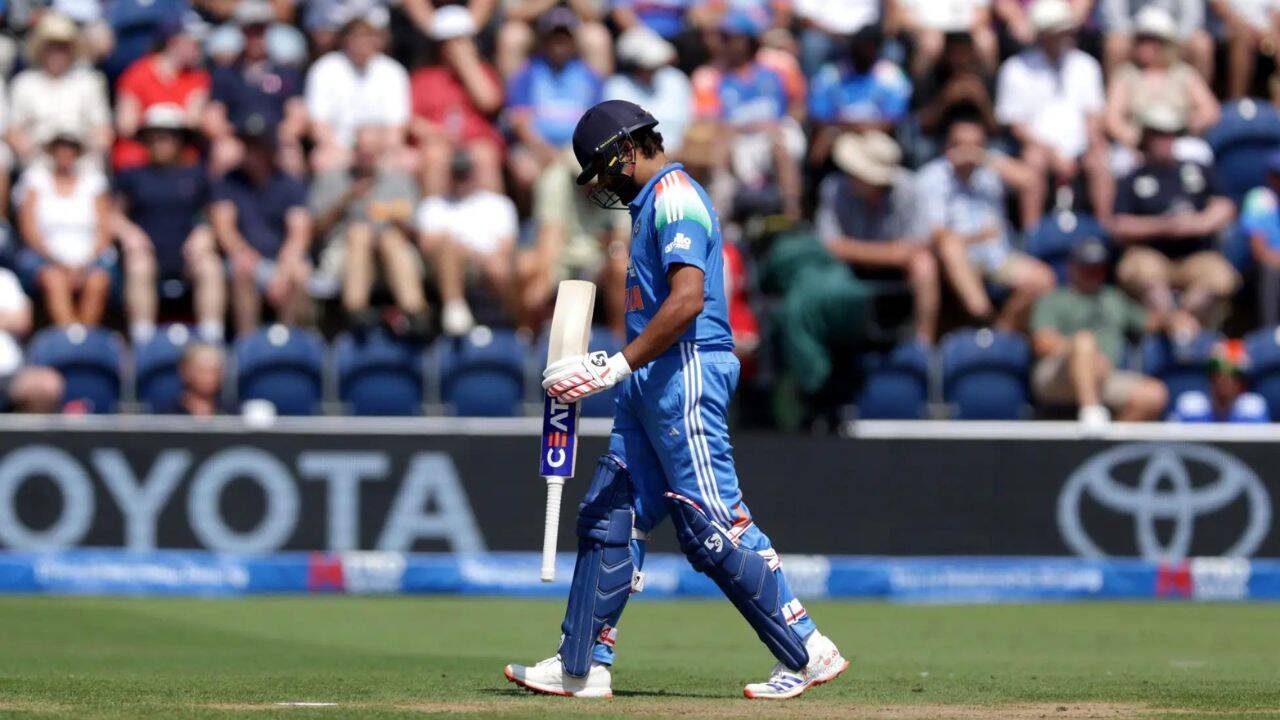
Where’s the Hitman?
For more than a decade, Rohit Sharma has been one of the defining figures of India’s ODI batting. The effortless pull, the languid drives, the ability to turn a quiet start into a match-defining hundred — these have been central to the legend of the “Hitman”. But in the first two ODIs against England, the familiar rhythm has been missing.
With just 37 runs across two innings, prolonged dot-ball phases and visible discomfort against pace, Rohit’s form has become more than a short-term talking point. It is now a serious question in the context of India’s long-term ODI planning, especially with the 2027 ODI World Cup on the horizon.
A Struggle Beyond Just Low Scores
Every batter goes through lean patches. Rohit Sharma has had them before and has often responded with authority. But what has stood out recently is not merely the lack of runs — it is the manner of dismissal, the lack of fluency and the difficulty in controlling tempo.
In his prime, Rohit’s early-innings approach was built on calm accumulation. He could absorb pressure without looking trapped. Against England, however, the dot balls have piled up quickly, creating pressure not only on him but also on the non-striker and the middle order. That is unusual for a player who has historically dictated the pace of an ODI innings with such command.
Timing and Tempo: The Two Missing Pieces
Rohit’s batting has always been about timing rather than force. When he is in form, even defensive strokes look controlled and attacking shots appear effortless. But in these ODIs, his timing has looked uncertain. Balls he would normally clip through midwicket or punch through cover have either found fielders or beaten the bat.
The bigger issue is tempo. Modern ODI cricket demands aggressive intent from the first powerplay. India’s recent white-ball blueprint has been built around putting pressure on bowling attacks early. Rohit himself championed that approach during the 2023 World Cup, where he gave India explosive starts. But at the moment, he appears caught between caution and aggression — neither fully attacking nor comfortably rotating strike.
Discomfort Against Pace Raises Red Flags
Perhaps the most concerning sign has been Rohit’s visible discomfort against high-quality pace. England’s fast bowlers have targeted him with hard lengths, movement and changes of angle. Rohit has not looked settled against deliveries rising into the body or seaming away from a good length.
This matters because the 2027 World Cup will be played in conditions where pace and bounce could play a major role. If India are planning for that tournament, they must assess whether their top order can consistently handle fast bowling in demanding conditions. Rohit’s experience is invaluable, but selection for a future World Cup cycle cannot be based on reputation alone.
The Confidence Question
Great players often talk about confidence as something that returns with one good innings. For Rohit, that may still be true. One fluent knock could change the conversation entirely. But right now, his body language suggests a batter searching for answers.
There have been moments of hesitation: half-committed footwork, delayed shot selection and an uncharacteristic inability to dominate loose deliveries. These are not technical problems alone. They point to a batter whose confidence is not at its usual level.
What Does This Mean for India’s ODI Plans?
India’s selectors and team management face a delicate decision. Rohit Sharma is not just another senior player. He is a World Cup-winning leader figure, one of India’s greatest ODI openers and a batter with a record that demands respect. Dropping or phasing out such a player is never simple.
However, India must also look ahead. The 2027 World Cup is still some distance away, but planning for it cannot begin too late. If Rohit is to remain part of that vision, there needs to be clarity around his role, fitness, form and ability to sustain the demands of modern ODI cricket.
The Young Openers Waiting in Line
India are not short of options. Younger batters are pushing hard across formats, bringing energy, strike rotation and fearless intent. The presence of emerging openers makes the debate sharper. If India want to build a settled top order for 2027, they may need to give extended opportunities to the next generation rather than rely heavily on ageing stars.
That does not mean Rohit’s ODI career is over. Far from it. But it does mean his place can no longer be treated as automatic if the runs and impact do not return soon.
Why Rohit Still Deserves Time
Despite the growing concerns, writing off Rohit Sharma would be premature. His ODI record is elite, his understanding of the format is unmatched and his ability to produce big hundreds remains one of his strongest assets. Few players in world cricket can change a match as dramatically once set.
India also know the value of experience in major tournaments. Rohit has been through pressure situations, hostile conditions and high-stakes knockout games. If he can rediscover his rhythm, he remains a major asset.
The Road Ahead
The immediate challenge for Rohit is simple: spend time at the crease, reduce dot-ball pressure and regain trust in his scoring areas. He does not need to manufacture aggression. He needs to find the timing that once made his batting look effortless.
For India, the challenge is more strategic. They must balance respect for a legend with the demands of future planning. Sentiment cannot drive selection, but neither should short-term form erase years of proven excellence.
Final Word
Rohit Sharma’s struggles in the first two ODIs against England have opened up a conversation India can no longer ignore. The low scores, dot-ball phases and discomfort against pace are genuine concerns. For a team already thinking about the 2027 World Cup, every senior player’s role must be examined honestly.
The Hitman may yet return with a statement innings. Champions often do. But until then, the question will only grow louder: where is Rohit Sharma, the ODI force India once built their innings around?